
Posted At: Oct 06, 2026 - 18 Views

Imagine overlaying digital information seamlessly onto the world around you—turn-by-turn navigation floating on the street ahead, real-time translations appearing on foreign signage, or hands-free assembly instructions guiding factory workers through complex tasks. See-through augmented reality glasses make this possible by projecting computer-generated imagery directly into your field of view while maintaining full awareness of your physical surroundings. The technology behind these devices sits at the intersection of optics, microelectronics, and materials science, representing one of the most demanding manufacturing challenges in consumer electronics today.
The Fundamental Challenge of See-Through Optics
Creating an augmented reality experience requires solving a deceptively complex problem: how do you display digital content in a way that appears to exist in the real world while keeping that real world fully visible? Unlike virtual reality headsets, which block out the environment entirely, see-through AR glasses must transparently combine virtual content with the physical world without compromising either.
The core challenge lies in the optical architecture. A display module must generate an image, and that image must be redirected from its source to the viewer's eye in a way that allows ambient light to also reach the retina. Traditional optical designs fail here because they require either blocking light (like a projector screen) or producing images too small to be useful. Modern see-through AR glasses solve this through specialized waveguide technology that guides light along a precise optical path while maintaining transparency.
Waveguide Optics: The Heart of See-Through AR
Waveguide-based optical systems have emerged as the dominant approach for consumer see-through AR glasses. These systems consist of thin, transparent substrates—typically made from optical-grade plastics or glass—that guide image-bearing light from a microdisplay to the user's eye through a phenomenon called total internal reflection.
A typical waveguide assembly includes three key components working in concert. The input coupler captures light from the microdisplay and introduces it into the waveguide at an angle that allows total internal reflection. The waveguide itself transports this light across its surface, maintaining optical fidelity despite the device's compact form factor. Finally, the output coupler extracts light at precise locations, directing it toward the eye's pupil while allowing external light to pass through unimpeded.
Different manufacturers employ various techniques for these coupling functions. Some use holographic optical elements (HOEs) that record interference patterns directly into photopolymer materials. Others rely on diffraction gratings etched at microscopic scales into the waveguide surface. Still others employ geometric approaches with precisely angled surfaces. Each method offers distinct trade-offs in terms of field of view, brightness efficiency, color reproduction, and manufacturing complexity.

Microdisplay Technologies Powering AR Glasses
The microdisplay serves as the image source for any AR system, and its characteristics directly impact the overall quality of the augmented reality experience. These tiny displays, typically measuring less than one inch diagonally, must produce sufficiently bright, high-resolution images while consuming minimal power and generating little heat.
Three primary microdisplay technologies dominate the AR landscape today. Liquid Crystal on Silicon (LCoS) displays use a liquid crystal layer atop a silicon backplane to modulate light from a separate illumination source. This approach offers excellent color accuracy and high resolution, making it popular for enterprise-grade AR devices where image quality is paramount.
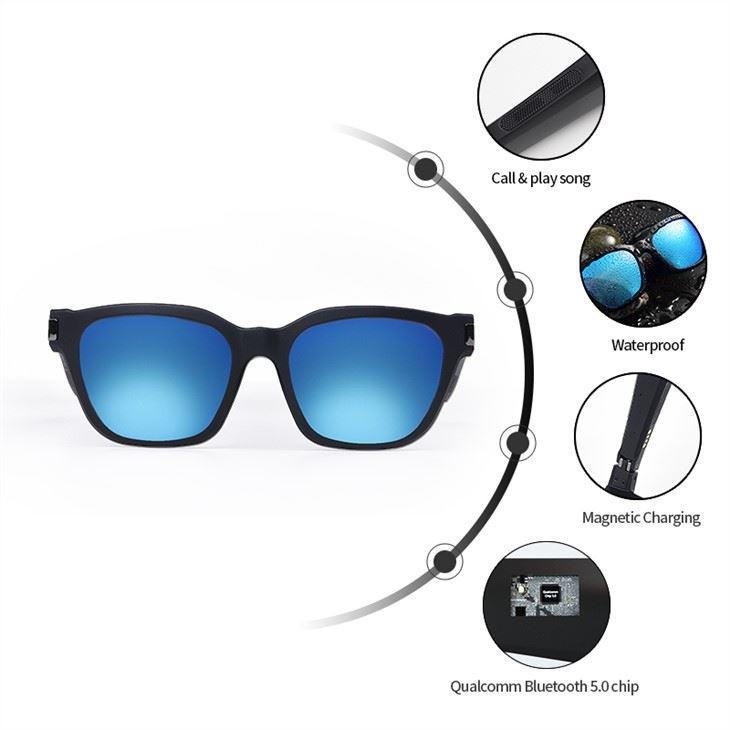
Organic Light-Emitting Diode (OLED) microdisplays emit their own light, eliminating the need for backlighting and enabling true blacks and potentially infinite contrast ratios. This self-emissive characteristic makes OLEDs particularly attractive for consumer-oriented products where visual impact matters. Android fashion Bluetooth smart glasses increasingly incorporate OLED technology to deliver vibrant visuals in stylish form factors.
MicroLED represents the emerging frontier in AR microdisplays. This technology offers the self-emissive benefits of OLED with potentially higher brightness, better longevity, and improved power efficiency. However, manufacturing challenges have limited MicroLED availability for AR applications, though major manufacturers are actively scaling production capabilities.
Critical Optical Specifications for B2B Evaluation
When evaluating AR glasses for OEM/ODM partnerships, several optical specifications demand careful attention. Field of view (FOV) determines how much of the real world can be overlaid with virtual content. Current consumer devices typically offer 30-50 degrees horizontal FOV, while enterprise solutions may extend to 70 degrees or beyond. Wider fields of view create more immersive experiences but generally require larger waveguides and more powerful microdisplays.
Eye box size—the region where the eye must be positioned to see the full image—affects comfort and usability. Devices with larger eye boxes accommodate greater variability in how users wear their glasses, reducing fitting challenges during deployment. Exit pupil diameter determines how much light enters the eye and directly impacts perceived brightness. Outdoor visibility often requires peak brightness exceeding 2000 nits, a demanding specification that influences both microdisplay choice and waveguide efficiency.
| Specification | Consumer Range | Enterprise Range | Manufacturing Impact |
|---|---|---|---|
| Field of View (Horizontal) | 30-50 degrees | 50-80 degrees | Waveguide size and coupling complexity |
| Eye Box | 8-12mm | 12-20mm | Output coupler design tolerance |
| Peak Brightness | 1000-3000 nits | 3000+ nits | Microdisplay power and thermal management |
| Resolution | 720p-1080p per eye | 1080p-4K per eye | Microdisplay pixel density |
| Weight | 30-80 grams | 80-150 grams | Material selection and structural design |
Form Factor Engineering for Wearable Comfort
Achieving widespread consumer adoption requires AR glasses that people actually want to wear. This demands aggressive miniaturization and weight reduction without sacrificing optical performance. The most successful devices balance these competing requirements through innovative mechanical engineering and thoughtful material selection.
Modern AR glasses must integrate multiple subsystems within a frame that typically weighs between 40 and 80 grams—comparable to standard eyeglasses. These subsystems include the optical engine (waveguide, microdisplay, and associated optics), sensor array (cameras, microphones, and potentially depth sensors), processing unit, battery, and wireless connectivity hardware. Thermal management adds further complexity, as processing components and displays generate heat that must be dissipated without causing user discomfort.
Manufacturers employ various strategies to address these challenges. Some designs distribute weight through extended temple arms that position batteries and processors behind the ear. Others utilize titanium and magnesium alloys to reduce frame weight while maintaining structural rigidity. Carbon fiber composites offer excellent strength-to-weight ratios but present manufacturing challenges that increase production costs.
Prescription Lens Integration and Accessibility
For AR glasses to achieve mass market success, they must accommodate users who require vision correction. This requirement adds significant complexity to both design and manufacturing. Several approaches address this challenge, each with distinct advantages and limitations.
Insert-compatible designs provide dedicated mounting points for prescription lens carriers that users can install or swap as needed. This approach preserves the core device's industrial design while offering flexibility for different users. However, it increases overall system thickness and weight, and requires users to manage multiple components.
Waveguide-based designs can incorporate prescription corrections directly into the waveguide substrate itself, eliminating separate lens components. This solution produces the sleekest final product but requires custom manufacturing for each user, dramatically complicating supply chain management and inventory.
Adjacent frame designs mount prescription lenses in a traditional frame worn alongside or clipped to the AR device. While less elegant, this approach offers the broadest compatibility and simplest inventory management for manufacturers serving diverse markets.
Manufacturing Considerations for OEM/ODM Partnerships
Selecting the right manufacturing partner for see-through AR glasses requires evaluating capabilities across multiple dimensions. Optical manufacturing demands precision tolerances measured in microns, cleanroom environments for waveguide production, and sophisticated metrology equipment to verify optical performance.
Waveguide fabrication presents particular challenges. Diffractive optical elements require electron beam or laser lithography systems capable of patterning features at nanometer scales. Holographic waveguides demand specialized recording setups with vibration isolation and precise environmental control. Quality verification requires interferometric testing and MTF (Modulation Transfer Function) measurement equipment that most contract manufacturers cannot justify for low-volume production.
Final assembly integration combines multiple precision components into a cohesive product. Aligning waveguides to microdisplays, calibrating optical performance, and ensuring cosmetic quality across production volumes demands experienced technicians and sophisticated fixture systems. Testing protocols must verify not only optical performance but also environmental robustness—temperature extremes, humidity exposure, and mechanical shock all potentially impact delicate optical systems.
Supply Chain Resilience for AR Component Sourcing
The specialized components required for see-through AR glasses create supply chain vulnerabilities that B2B buyers must carefully evaluate. Microdisplays remain available from only a handful of specialized suppliers globally, creating potential bottlenecks that can delay production schedules or inflate component costs.
Waveguide manufacturing capacity remains limited compared to demand expectations. Most production facilities operate below the scale needed to support projected market growth, and expanding capacity requires substantial capital investment with multi-year timelines. This constraint makes it essential for B2B buyers to establish firm commitments with manufacturing partners who control their own waveguide production capabilities.
Sensor components including cameras, microphones, and inertial measurement units present similar concentration risks. The systems-on-chip powering AR glasses often require custom configurations that further constrain supplier options. Robust OEM partnerships require manufacturers with established relationships across this component ecosystem and contingency strategies for supply disruptions.
Application Domains Driving Market Demand
Enterprise applications currently drive the majority of see-through AR glass deployments. Industrial maintenance and repair workflows benefit from hands-free access to technical documentation, remote expert guidance, and real-time sensor data overlays. Field service technicians equipped with AR glasses complete complex repairs faster and with fewer errors than traditional approaches.
Manufacturing and logistics operations increasingly deploy AR glasses for training, quality assurance, and process guidance. Assembly line workers receive step-by-step visual instructions directly in their work area, reducing error rates and accelerating onboarding of new employees. Warehouse pickers navigate optimized routes while receiving real-time inventory updates overlaid on their physical environment.
Healthcare applications represent an emerging opportunity space. Surgeons access patient vital signs and imaging data without looking away from the operative field. Nurses receive medication administration verification and patient information during rounds. Medical training programs use AR overlays to simulate anatomical structures and procedural scenarios.
Consumer applications will ultimately drive the largest market volumes, though technical and usability challenges continue to limit adoption. Navigation, language translation, photography, and entertainment represent near-term consumer use cases. As devices become lighter, more stylish, and more affordable, adoption will likely accelerate across these domains.
Partnering for AR Glasses Manufacturing Success
The complexity of see-through AR technology makes selecting an experienced manufacturing partner essential for market success. Look for partners who have invested in vertical integration, controlling waveguide production, optical assembly, and final system integration under one roof. This integration enables tighter quality control, faster iteration cycles, and more predictable production schedules.
Evaluate potential partners' track records with similar optical consumer electronics, not just general electronics manufacturing experience. The precision requirements for AR glasses differ substantially from smartphones or other mainstream devices, and experience with related optical technologies like cameras or displays provides valuable foundation knowledge.
Consider the partner's commitment to continuous improvement and technology roadmap. The AR glasses market evolves rapidly, with new waveguide technologies, microdisplay capabilities, and sensor integrations emerging regularly. Manufacturing partners who invest in R&D and maintain relationships with component suppliers position their customers to access these advances as they become production-ready.
Black technology smart sunglasses represent one example of how manufacturers combine advanced functionality with consumer-friendly aesthetics. Such products demonstrate the balance between technical performance and market appeal that defines successful AR glasses.
Ready to explore see-through AR glasses manufacturing for your brand? Our engineering team has delivered dozens of AR and smart glasses products to markets worldwide. Share your requirements and let's discuss how we can bring your vision to life.
